If you’re deciding between Sylius vs Magento, now is a crucial time to understand the differences. The online retail industry is skyrocketing. The COVID-19 pandemic accelerated the speed of e-commerce development even more. It forced thousands of people to stay at home and choose a safer option for shopping – purchasing online. As a result, consumers have become increasingly demanding when it comes to the design and functionality of online stores. Features such as mobile-friendly layouts, a variety of payment methods, and guaranteed safe shopping experiences are now considered essential for any e-commerce platform.
No wonder that the number of online store platforms on the market is also growing rapidly. According to G2, there are over 370 e-commerce platforms available for businesses today. Among the most popular platforms are Magento, PrestaShop, Shopify, and WooCommerce, but many other solutions are also available.
Currently, there are over 370 e-commerce platforms available.
For entrepreneurs preparing to launch an online store, choosing the right e-commerce platform is a critical decision.
This article aims to help you make an informed choice by providing a detailed comparison of two prominent platforms: Sylius and Magento. The comparison includes technical vocabulary and is ideal for readers familiar with e-commerce tools and development.
If you’d like to explore other platforms, check out the article How to choose the best online store for your business.
Sylius vs. Magento — introduction
Sylius is an open source headless e-commerce platform created as a Symfony-based, API-first e-commerce framework. It is made for mid-market and enterprise businesses that require highly customizable, tailored solutions. Its API-first approach enables flexible integrations and seamless data exchange with third-party services. This makes it ideal if your company needs easier customization and faster, more responsive user experiences. It is built on the Symfony framework—one of the most popular and robust PHP frameworks—and it utilizes a REST API. That is why Sylius offers developers great flexibility in customization. Its Behavior Driven Development approach focuses on delivering business value rather than just writing code.
Although Sylius currently supports around 2,500 merchants, it is rapidly growing, having been downloaded over 65,000 times in the last 30 days.

Magento, on the other hand, is a widely recognized open source e-commerce platform written in PHP and developed on the Zend Framework. It is known for its flexibility and extensive customization options. Now part of Adobe Commerce, Magento offers full control over the look and functionality of online stores.
The platform is highly scalable and supports numerous integrations with third-party services such as ERP and PIM systems, making it an excellent choice for enterprise businesses and companies aiming for fast growth. The broader Magento ecosystem includes a vibrant community, a wide range of integrations, and a robust marketplace, all of which contribute to its strong market positioning and user experience. With over 250,000 Magento online stores worldwide, Magento boasts one of the largest market presences among e-commerce platforms.
Sylius vs. Magento — a detailed comparison
Let’s delve deeper into the similarities and differences between Sylius and Magento, focusing on critical aspects that can influence your choice.
Sylius vs. Magento — the most important features and different platform versions
Sylius versions and features
Starting with Sylius, the platform has evolved steadily since its initial release:
- Sylius 1.0 was launched on September 13, 2017.
- Sylius 1.9, the latest version, was released on September 14, 2020.
- Sylius Standard is the free, open source version licensed under the MIT license. This permissive license allows you to use the platform and implement functionalities freely. The only requirement is to include the original copyright and license notice. Sylius Standard comes with essential built-in features for eCommerce, such as product catalog management and basic order processing.
-
Sylius Plus is the advanced, commercial version of the platform. It offers enterprise-grade features such as loyalty programs and multi-source inventory. You can also create separate admin roles for each sales channel. The Standard version comes with a set of built-in features. In addition to these, Sylius Plus provides even more. It includes advanced customer segmentation, enhanced security and SLA-backed support. It limits the ability to modify core features independently; however, you can propose enhancements to the core team.
Sylius is built on the Symfony PHP framework. This allows developers to leverage a wide range of Symfony bundles to extend platform functionality and integrations. The large pool of Symfony developers in the market also makes it easier to find expertise for Sylius projects. This reduces development and maintenance costs.
Magento versions and features
Magento offers several versions to cater to different business needs:
- Magento Open Source (Community Edition) is free and provides essential features to build a minimal viable product (MVP) online store.
- Magento Commerce (Enterprise Edition) is the paid version, offering a comprehensive feature set, advanced tools, and enhanced architecture. It is ideal for larger online stores seeking rapid growth and includes advanced order management capabilities for inventory control, order processing, and fulfillment.
- Magento 1 and its subversions (e.g., 1.7, 1.8, 1.9) were supported officially until June 2020.
- Magento 2, the latest major release, includes improvements such as faster performance, an enhanced administration panel, better mobile support, and easier scalability. It also supports integrations with external systems like ERP and PIM.
Sylius vs. Magento — marketing and SEO features
In today’s competitive e-commerce landscape, effective marketing and SEO features are essential for store success. When comparing Sylius vs Magento in this area, Magento clearly offers more out-of-the-box marketing functionalities.
Sylius Plus includes tools for email campaigns, content and reviews management, and CRM capabilities, but these are only available in the paid version. Meanwhile, Magento offers many marketing solutions even in its Open Source version for free. Magento supports up-selling and cross-selling, customizable category landing pages, and the creation of coupons and discounts tailored to multiple stores, customer groups, and product categories.
Below is the Magento marketing dashboard and its additional features:
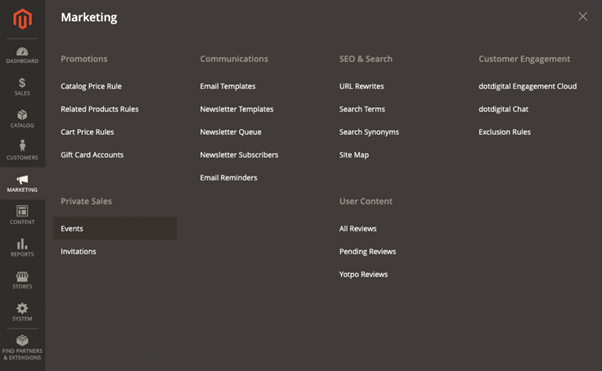

Regarding SEO, Sylius falls short in both its Standard and Plus versions. It lacks built-in SEO management options. To enhance search visibility, users must rely on dedicated SEO extensions.
In contrast, Magento includes extensive SEO features such as meta descriptions and titles for products and categories, sitemap generation, synonym search, 301 redirects, and custom URLs. Importantly, these SEO tools are available in both Magento’s paid and free versions.
Sylius vs. Magento — how much does it cost?
Cost is a key metric when selecting an e-commerce platform. Sylius Standard is free and suitable for building simple online stores with basic features. Sylius Plus pricing follows a Gross Merchandise Volume model. This means the cost is adjusted according to your store’s size. Prices start at approximately €14,900 per year. However, you need to contact Sylius for a personalized quote.
Magento Open Source is also free and offers more functionalities than Sylius Standard. However, Magento Commerce’s licensing fees are significantly higher. These fees depend on your store’s annual gross revenue. The on-premise Magento Commerce plan starts at around $22,000 per year. The cloud-hosted version begins at approximately $40,000 annually.
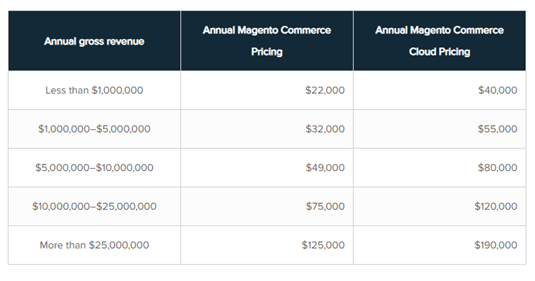

Source: magestore.com
Bear in mind that these prices cover licensing only; additional expenses for hosting, support, and development services should be considered. Despite the higher total cost, Magento offers a comprehensive solution worth the investment for many businesses.
Click here to find out how much a store on Magento costs.
Sylius vs. Magento — scalability
Scalability is the key factor of each e-commerce platform when your online store starts growing and expanding to other markets. It is the ability to keep high performance rates while adding many new items into your store and acquiring more customers. Since this measure is so important, we decided to take a closer look at the scalability parameters of Sylius and Magento.
Sylius scalability rates are impressive. As mentioned in one of the Sylius case studies, the platform can hold 500 simultaneous orders while increasing the productivity rate up to 30%. Sylius is also able to grow the number of unique items in an online store from around 40,000 units, to over 62,000 in less than 6 months from going live.
Although Sylius scalability is one of its strengths, Magento is outperforming it. Magento can hold up to 50,000 visits hourly and numerous products simultaneously thanks to its explicit inventory management.
Below we present the results from performance & scalability test of Magento platform:
Merchant profile
Both scenarios assumed the following Magento store profile:

Small Merchant Deployment ($1-$5M) — orders per hour

Large Merchant Deployment ( $50-$100M) — orders per hour

Source: Magento 2.0 Site Performance and Scalability Optimizations (pdf)
Performance and scalability tests on Magento versions show that Magento Enterprise Edition 2.0 significantly increases orders per hour compared to Magento 1 and Sylius. This is especially true in large merchant deployments ($50–$100 million revenue). While the Sylius test details are limited, Magento’s proven scalability makes it a preferred choice for larger enterprises.
Sylius vs. Magento – speed and performance
Website loading speed is a very key metric affecting user experience and conversion rates. Generally, a web page should begin rendering within 3 seconds to keep users engaged. Reducing the Time To First Byte (TTFB) is crucial. It allows the browser to begin rendering web content faster, directly improving user experience.
The speed at which the initial markup is delivered from the server is also vital—Google recommends a TTFB of less than 300 ms to ensure optimal page load speed and user satisfaction. Longer load times often lead customers to abandon the site. Additionally, optimizing web page content is essential for faster loading and better SEO rankings.

Source: cloudflare.com
Sylius tends to offer better speed and performance compared to Magento, with Sylius-powered websites loading up to three times faster. It also delivers great performance out-of-the-box. This makes it a strong choice for businesses prioritizing efficiency. This advantage stems from Sylius’s modular architecture and lean core that avoids unnecessary bloat. It also supports compatibility with various front end technologies for seamless integration and enhanced flexibility.
However, many factors impact speed, including image sizes, hosting quality, the number of plugins, and code optimization. Magento is a resource-intensive platform due to its comprehensive feature set and extensibility. This can result in slower performance. Fortunately, there are proven methods to speed up Magento stores, including optimized hosting and caching strategies.
If you lack the technical expertise, hiring experienced Magento developers or an agency specializing in Magento commerce can help enhance your store’s performance.
Sylius vs. Magento – online store security
Security is paramount for any e-commerce business to protect sensitive customer data and maintain trust.
When it comes to this point, both Sylius and Magento have a few things in common.
Both Sylius and Magento rely on regular security patches. Sylius issues patches to address vulnerabilities and occasionally provides fixes that do not require patch installation. The latest Sylius security patch was released in August 2020.
Magento Open Source also releases frequent security updates. Magento Commerce includes default security features and offers additional ways to enhance protection. The Magento 2 platform receives regular patches, with the most recent update in October 2021. Although Magento 1 is no longer officially supported, experienced developers can still secure it effectively.
For more information on Magento store security, check out our blog article on protecting your store from hacking attacks.
Which platform is easier to use?
When comparing Sylius vs Magento in terms of ease of use, Sylius is generally more beginner-friendly. Its relatively young and developer-friendly platform features straightforward code, making it accessible for those new to e-commerce development. This allows entrepreneurs to create and maintain their online stores without requiring extensive technical expertise at the start.
Magento, being a more complex and feature-rich platform, has a steeper learning curve. It typically requires a team of experienced developers and e-commerce experts to manage, maintain, and expand the store effectively. Hiring a professional e-commerce agency specializing in Magento services is often necessary for optimal results.
Support services and professional help from experts
Support and professional resources are vital for ongoing e-commerce business development.
Sylius, having been on the market for about five years, has a smaller community and fewer dedicated support agencies. However, it provides documentation, video tutorials, and discussion forums. The Symfony developer community also offers significant technical resources, given Sylius’s foundation on the Symfony framework. Still, the pool of Sylius experts remains limited compared to Magento.

Magento benefits from a large, active community and a vast ecosystem. With around 150,000 trained Magento developers and 250,000 Magento online stores worldwide, users have access to extensive tutorials, forums, and official support channels. These include the Magento Help Center and Magento Stack Exchange.
Extensions and plugins
Extensions and plugins enable you to add functionalities and improve your online store’s performance.
Sylius, being younger and less mature, offers around 65 extensions in its marketplace. Most are free, with only a few paid options ranging from €350 to €2,950. These extensions cover fundamental e-commerce features.
Magento’s ecosystem is far more extensive, with over 4,000 extensions and plugins available in the Magento Marketplace. These cover various categories and platform editions (Open Source, Commerce on-premise, Commerce on Cloud) and versions (2.4, 2.3, 2.2, and earlier). Additionally, Magento offers multiple themes, both free and paid, enhancing store customization.
Sylius vs. Magento – which platform to choose?
Ultimately, the choice between Sylius and Magento depends on your specific business needs, technical expertise, and growth ambitions.
(We highly recommend creating a business plan in which you include your milestones, indicating the most important goals to achieve on your way to e-commerce growth and success).
Sylius is a better fit for beginners and small businesses seeking a highly customizable, developer-friendly, open source platform without incurring high licensing fees. It suits companies with limited budgets and those not expecting rapid growth in the near future.
Sylius will be a better choice for those without much experience in the e-commerce industry.
Magento caters to a broader range of businesses—from small to large enterprises. It offers a comprehensive, scalable solution with extensive features and integrations. While it demands more technical expertise and higher initial and maintenance costs, Magento provides unmatched scalability. It also includes extensive marketing and SEO tools, along with a large community of developers and support resources.
Magento Open Source is ideal for small to medium stores. It can also support larger stores with the right technical setup. Meanwhile, Magento Commerce provides additional enterprise-grade features and support for large-scale operations.
Want to learn more about Magento, its support, and development for your store? Click below to schedule 15 minutes for a free consultation.
.
.
Zamów bezpłatną konsultację
.
Z nami rozwój Twojego biznesu nabierze tempa! Zapraszamy do kontaktu średnie i duże firmy generujące min. 7 mln PLN obrotu rocznie – tam nasza ekspertyza sprawdza się najlepiej.
.
Kliknij w poniższy przycisk i skontaktuj się z jednym z naszych konsultantów e-commerce
.